

Summary
Winocour Law secured a $4 million settlement on behalf of a 3-year-old child who fell approximately 30 feet from a third-story apartment window during a children’s party.
The window should never have opened that far. A required safety device, widely available and inexpensive, was missing, despite the landlord having already promised to install it. Here, we share the outcome in general terms to protect our clients’ privacy and to show how a case like this comes together: through building-code analysis, careful documentation of what a landlord knew and ignored, and patience with a type of injury that takes years, not months, to fully understand.
Factual Overview
- What happened: During a children’s party at a Dallas-area apartment complex, several children were playing in a “sunroom” off the main living area, a small space with a large, three-panel window that dropped almost to the floor. One of the children was able to push the window open far beyond the opening it was legally allowed to have, and the 3-year-old client fell out, roughly 30 feet to the ground.
- Injuries sustained: Our client suffered a serious head injury and an eye injury, along with bruising and contusions. The most significant and lasting harm was a traumatic brain injury (TBI). Though he was not expected to require daily long-term care, the injury did cause cognitive deficits likely to affect his education and, over time, his future personal and professional prospects.
- Why it happened: The window lacked a required safety stop that limits how far a window can open, a device meant specifically to prevent this kind of fall from an upper floor. Residents of the unit had already asked the landlord to install these stops. The landlord agreed to do it, but never followed through. Other units in the same complex already had them installed.
Who We Pursued, and Why
We sued both the corporate entity that owned and operated the apartment complex and, individually, a high-net-worth principal of that entity. Part of our early investigation looked at whether we could pierce the corporate veil to reach that individual’s personal assets directly. Ultimately, the evidence showed he was properly protected through the corporate structure, and the complex carried adequate insurance to cover the claim.
That’s a routine part of how we approach any serious injury case: identify every party who may bear responsibility, individual or corporate, and investigate each one on the facts, rather than assuming the obvious defendant is the only one worth naming.
The Evidence That Proved the Case
1) A window that was never supposed to open that far
Building codes, including the International Building Code adopted by most cities, require that windows above the ground floor be fitted with stops limiting how far they can open, typically to about 8 inches, specifically because children are drawn to windows and can fall through a wider opening. This window had no stops at all. In one deposition, we used a small ball sized to that 8-inch limit, the same kind of tool a building inspector carries, to make a simple point: if the window opens wide enough to pass the ball through, it fails code.
2) A fix that costs less than lunch
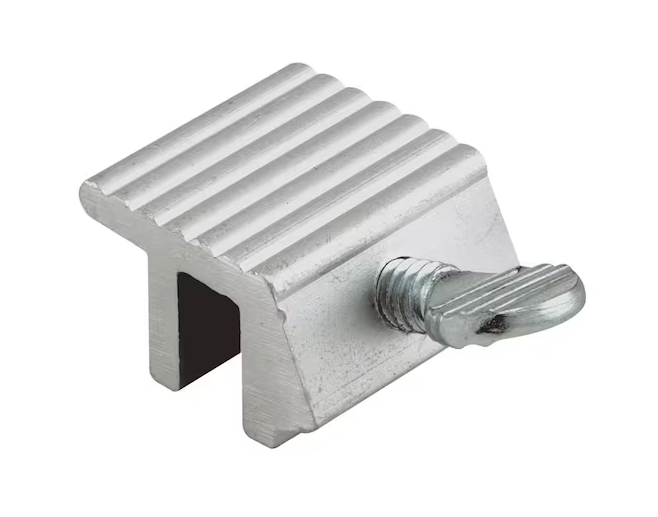
The stops that should have been installed cost only a few dollars and take minutes to install. That was significant because it eliminated any argument that fixing the problem would have been burdensome or expensive for the landlord. To make matters worse for the defense, other apartments in the same complex already had the window stops installed, which meant the landlord could not credibly claim the fix wasn’t feasible for property management.
A window stop like this one, roughly $3–$5 apiece, is designed with a hex screw rather than a thumb screw so a child can’t easily remove it.
3) Gaps in the paperwork became leverage
During discovery, we found gaps in the complex’s records of maintenance requests and complaints, including records related specifically to our clients’ repeated requests to have the window fixed. Those gaps put property management under real pressure in deposition: either the records were incomplete, or the requests had been received and ignored. Neither answer helped the defense.
We also relied on a legal theory called “negligent undertaking.” Once the landlord agreed to fix the window, they assumed a specific duty to do so. Failing to follow through on that promise gave us a stronger, more specific claim than a general premises defect argument alone, and it was enough to get the defense’s summary judgment motions denied before the case settled.

Anticipated Defenses
“The parents weren’t watching closely enough.”
The defense raised the possibility that the parents supervising the party bore some responsibility for not watching the children more closely in the moment. Texas law on whether, and how, a young child can be found contributorily negligent is genuinely unsettled, and we were prepared to litigate that question.
But the underlying facts made the argument a hard sell regardless: a window that isn’t supposed to open wide enough for a child to fall through shouldn’t depend on a parent standing next to it at all times to prevent that exact outcome.
Why We Didn’t Rush This Case
Pediatric brain injuries are notoriously hard to evaluate early. A 3-year-old is too young to meaningfully test for cognitive impairment; there’s no baseline to compare against. It typically takes years, not months, before a child is old enough for reading, math, and other developmental benchmarks to reveal what an injury actually cost him. Settling early, before that picture comes into focus, is one of the more common ways brain-injury cases get undervalued.
The injury occurred in 2019, just before the COVID-19 pandemic, and the case settled roughly five years later. Some of that time came from pandemic-related delays in the courts, and some of it was a strategic choice to wait until our client was old enough for a pediatric neurologist, an educational specialist, and a pediatric rehabilitation specialist to properly assess his long-term cognitive and educational prospects, rather than guessing at a number early and living with it.
What the $4 Million Settlement Actually Means
We think it’s worth being direct about something here. This case settled for $4 million in present-value dollars. Because part of that recovery is structured as payments continuing over our client’s lifetime, the actual value to him over time will be considerably higher.
Still, we don’t advertise that larger number as “the settlement,” because it isn’t. $4 million is what the case resolved for. We’d rather a prospective client understand that distinction clearly than see an inflated number on a website and be misled about what a settlement actually means.
Structuring the settlement took real care. Because our client is a minor, the court appointed a guardian ad litem to represent his interests independently throughout the settlement process. We worked closely with that guardian and with a trustee to place the funds in a special needs trust.
That structure protects his long-term financial security without jeopardizing his eligibility for government benefits like Medicaid, which a large lump-sum payment could otherwise put at risk.
The Result
The case resolved for $4 million before the court needed to rule on the parties’ competing summary judgment motions. Our client is expected to be cognitively capable of completing school, though his educational path and, eventually, his career prospects will likely require ongoing support because of the injury. The settlement was structured to fund that support for the long term.
Key Takeaways
- A landlord’s own promises can become the strongest evidence against them. Once a property owner agrees to fix a known hazard, failing to follow through can create a more specific, more provable claim than a general premises-defect theory alone.
- Feasibility arguments cut both ways. A cheap, simple fix already installed in other units removes any argument that a repair was burdensome, expensive, or impractical.
- Gaps in a defendant’s own records can be as powerful as anything a plaintiff produces. Incomplete maintenance and complaint logs can put property management under real pressure in deposition.
- Pediatric brain injury cases require patience most lawyers don’t have. A young child’s long-term cognitive and educational prospects often can’t be fairly assessed for years after the injury. Settling early risks locking in a number well below what the case is actually worth.
- A settlement number and its lifetime value aren’t the same thing. Structured settlements can be worth far more over a client’s life than the present-value figure attached to the case.
If your child was seriously injured because of a landlord’s negligence, speak with a Dallas premises liability lawyer at Winocour Law. We can evaluate the evidence, explain your options, and help you understand what a serious injury claim involving a minor may involve.
Was your child seriously injured by someone else’s negligence?
This family recovered $4 million for their child’s traumatic brain injury. Find out what your family’s case may be worth — the consultation is free, and there are no fees unless we win.
Call Winocour Law — (214) 575-6060The Legal Team Behind This Result

Jonathan Winocour
Founder & Principal Attorney
A fourth-generation Texas trial attorney, Jonathan prepares every case as if it will go to trial. He has represented families in catastrophic injury and traumatic brain injury matters for more than two decades, building each case with the precision and preparation that drives full-value results.
- J.D., SMU Dedman School of Law (Dean’s List)
- Named Top 100 Trial Lawyer — The National Trial Lawyers
- Fourth-generation Texas attorney · 20+ years

Mike C. Miller
Of Counsel
Mike is Board Certified in Personal Injury Trial Law and a Fellow of the American Board of Trial Advocates — distinctions held by a small fraction of Texas attorneys. Across more than 40 years, he has tried catastrophic injury, traumatic brain injury, and wrongful death cases to verdict.
- J.D., University of Texas School of Law (1984)
- Board Certified, Personal Injury Trial Law — Texas Board of Legal Specialization
- Fellow, American Board of Trial Advocates · AV Preeminent® · 40+ years